If you own investment property and you're thinking about selling, "1031 exchange" is a term worth understanding before you list. It can be the difference between paying capital gains tax now or deferring it and putting your full equity to work in your next property.
Quick note before we dive in: this is a general explanation, not tax advice. The rules are strict and the deadlines are unforgiving, so always work with a qualified intermediary and a CPA or tax attorney before attempting one.
What a 1031 exchange actually does
Named after Section 1031 of the tax code, a 1031 exchange lets you sell an investment or business property and reinvest the proceeds into a "like-kind" replacement property, deferring the capital gains tax you'd otherwise owe on the sale. It doesn't eliminate the tax. It postpones it, potentially indefinitely if you keep exchanging.
"Like-kind" is broader than it sounds
In real estate, like-kind is interpreted loosely: almost any investment or business real property qualifies as like-kind to almost any other. You could exchange a rental duplex for a commercial building, or vacant land for an apartment complex. What doesn't qualify is your primary residence, or property held purely for personal use.
Two deadlines you cannot miss
This is where most exchanges fail, and it's non-negotiable: once you close on the sale of your property, you have 45 days to formally identify potential replacement properties, and 180 days total from the original sale to close on the replacement. There's no flexibility built into either deadline.
You can't touch the money
To qualify, the sale proceeds have to go directly to a qualified intermediary, a third party who holds the funds and handles the exchange paperwork. If the money passes through your hands, even briefly, the exchange is disqualified and the full gain becomes taxable. The intermediary needs to be lined up before your property even closes.
To defer the full gain, reinvest fully
As a general rule, to defer all of your capital gains tax, the replacement property needs to be of equal or greater value than what you sold, and you need to reinvest all of the net proceeds. Pull cash out, or buy something less expensive, and you'll likely owe tax on the difference.
Why investors use this strategy
Done well, a 1031 exchange lets you move your equity into a better-performing property, consolidate several smaller properties into one, or diversify into a different market, all without a tax bill eating into the capital you have to work with. Over multiple exchanges across a career, that compounding effect can be significant.
The real math: exchange vs. cash out
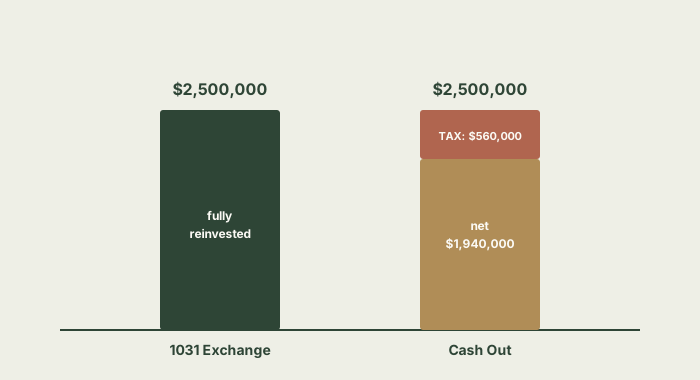
Numbers make this much more concrete than theory does. Here's a simplified, illustrative example: say you're selling an apartment building for $2,500,000, with an adjusted cost basis (original purchase price, minus depreciation you've claimed over the years) of $900,000, leaving you with a $1,600,000 gain. Using a blended illustrative rate of roughly 35% to account for federal capital gains tax, the 3.8% net investment income tax, and California state tax (which doesn't offer a reduced rate on capital gains), that gain would trigger somewhere around $560,000 in tax if you simply cashed out.