If you have owned your home in San Mateo County for a long time, there is a good chance your property tax bill is a fraction of what a new buyer next door is paying. That gap is the reason two questions come up in almost every conversation I have with long-time owners:
- "If we sell and move, are our taxes going to jump?"
- "Can our kids keep our tax bill when they inherit the house?"
The answers changed in 2021 when Prop 19 took effect, and a lot of families are still working off the old rules. Here is how it actually works today, in plain English.
Prop 13 in one paragraph
Under Prop 13, your home is assessed at what you paid for it. That is your "base year value." From there, the assessed value can rise by no more than 2% a year, no matter what the market does. Your tax bill is roughly 1% of that assessed value, plus local bonds and special assessments, which vary by city.
What that looks like on the Peninsula: A family that bought in San Carlos in 1995 for $350,000 is assessed at no more than about $650,000 today, even if the house would sell for well over $2 million. A buyer paying $2 million starts with a base three times higher, and a tax bill to match.
That base year value resets to current market value when the property changes ownership (a sale, and in many cases an inheritance) or when you add new construction, in which case only the new portion is reassessed. Prop 19 is about when you get to take that low base with you, and when you do not.
Part one: moving and taking your tax base with you
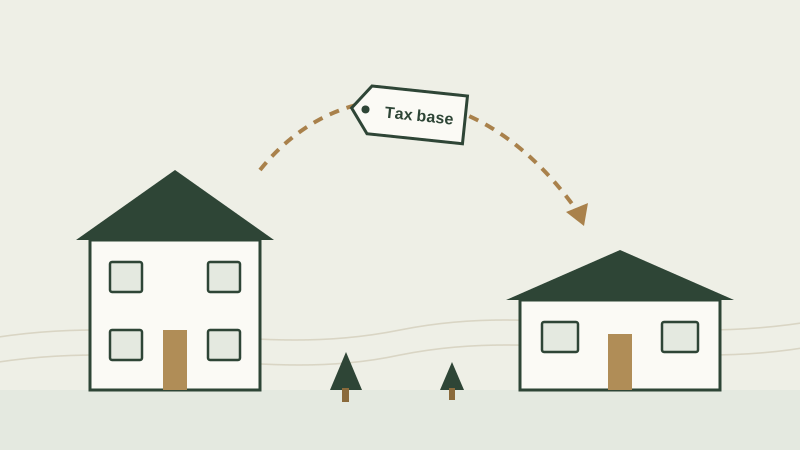
This is the good news side of Prop 19. You can transfer your existing taxable value to a replacement home if you are:
- 55 or older,
- severely disabled, or
- a victim of a governor-declared wildfire or natural disaster that substantially damaged your home.
The rules that matter most:
- Anywhere in California. The old rules limited you to certain counties. Now you can sell in Burlingame and buy in Sacramento, Tahoe, or down the street in Belmont.
- Up to three times for owners who qualify by age or disability.
- Two-year window. The replacement has to be bought or built within two years of selling the original home, before or after the sale.
- Both homes must be your primary residence. This does not apply to rentals or vacation homes.
- You can buy up. The replacement no longer has to cost less. If it costs more, the difference is added to your base.
Example: You are 67, your Hillsborough home has a taxable value of $600,000, and it sells for $2 million. You buy a single-level home in Redwood City for $2.3 million before the sale closes.
Your new taxable value would be about $900,000: your $600,000 base plus the $300,000 difference. A regular buyer of that same house starts at $2.3 million.
If you buy the replacement after you sell, you get a little breathing room. A replacement bought within the first year after the sale counts as "equal value" if it is up to 105% of what the old home sold for, and up to 110% in the second year.
For a lot of long-time owners I talk to, this is what finally makes downsizing make sense. Staying in a four-bedroom house you no longer need, just to protect a tax bill, is not really a reason to stay anymore.
Part two: inheriting a home (where families get caught off guard)
This is the side of Prop 19 that surprises people, and in my family's line of work, handling estates and trust sales, it is the part I see cause the most stress.
Before 2021, parents could pass their home to their kids, plus up to $1 million of other property, and the kids kept the low tax base whether they moved in, rented it out, or left it empty. That is gone.
Today, a child can keep a parent's taxable value only if:
- the home was the parent's primary residence,
- the child makes it their own primary residence within one year, and files for the homeowners' exemption, and
- the home's value stays under a cap.
That cap is the parent's taxable value plus an inflation-adjusted amount. For transfers between February 16, 2025 and February 15, 2027, that amount is $1,044,586. It is adjusted every two years, with the next change due in February 2027. Anything above the cap gets added to the tax base.
Example: Your parents' San Mateo home has a taxable value of $400,000 and is worth $2.5 million. The protected amount is $400,000 plus $1,044,586, or $1,444,586.
The remaining $1,055,414 is added to the base, so your new taxable value is roughly $1.46 million. That is still far below market, but more than three and a half times what your parents were paying on.
And if no one moves in, whether the plan is to rent it out, keep it as a second home, or just hold it for a while, the home is reassessed at full market value. The same goes for inherited rentals and vacation property. Grandchildren can qualify in some cases, generally when their parent (the grandparents' child) has passed away.
On the Peninsula, where a modest ranch house is often worth $2 million or more, the cap means very few inherited homes keep their full tax base anymore. For siblings inheriting together, it often turns the question from "who gets the house" into "does it make more sense to sell, or for one of us to move in and buy the others out."
What this means if you own in San Mateo County
If you are 55 or older and thinking about moving
Prop 19 gives you real flexibility. Plan the timing of the sale and purchase together, and know what your home is actually worth before you shop, since the value of both homes drives the math.
If you are planning your estate
Have this conversation with your estate planning attorney now, not later. A trust still matters for avoiding probate, but it does not protect the tax base on its own. The family should know ahead of time what the tax bill would look like if someone moves in, and what it would look like if no one does.
If you just inherited a home
The one-year clock to move in is the big one. Before you decide to keep, rent, or sell, get a realistic value on the home and a rough estimate of the new tax bill for each option. Those numbers usually make the decision much clearer.
The paperwork: Claims are filed with the San Mateo County Assessor. The common forms are BOE-19-B (55 and older), BOE-19-D (severely disabled), BOE-19-V (disaster victims), and BOE-19-P (parent-to-child transfers). There are filing deadlines, so do not let them sit.
A quick, honest note: I am a Realtor, not a tax attorney or CPA. These rules have details and exceptions that depend on your situation, so confirm your specific case with a tax professional or the Assessor's office before you make a decision. Where I can help is the part that drives all of this math: what your home, or the home you are buying, is really worth today.